
Icon article: Inside ‘The Big Repair’: An Archaeological Block-Lift of a Hull Fragment from HMS Victory
- View news filtered by: Napoleonic
- View news filtered by: Museum behind the scenes
- View news filtered by: Conservation
- View news filtered by type: Article

In December 2025, after months of material testing and research, members of HMS Victory: The Big Repair’s Conservation Team undertook an archaeological block-lift of a fragment of the ship’s hull. This removal now allows unhindered air flow around the remaining hull structure and also the first opportunity to examine the removed material up close.
HMS Victory (1765), once Vice-Admiral Lord Nelson’s flagship during the Battle of Trafalgar and still a commissioned Royal Navy vessel and flagship to this day, is currently three years into the decade long conservation project “HMS Victory: The Big Repair”. Due to exposure to weather for almost 250 years, HMS Victory has suffered extensive damage and ongoing deterioration – particularly to its starboard side. A team of conservators, archaeologists, heritage scientists, and traditional craftspeople (shipwrights and riggers) all work together to repair and conserve HMS Victory.
To allow the ongoing works, HMS Victory has been under scaffold cover since the very beginning of the conservation project in 2021. The scaffold structure offers a unique opportunity for staff to get up close to the ship and undertake the required work under cover, whilst at the same time enabling the public to view conservation in action from the “Victory: Live” viewing platforms.
Archaeological Significance and Context
In December 2025, members of the Conservation team removed a heavily degraded section of oak futtock (reference number WPE2224) from HMS Victory’s port side. The futtocks form the supporting ‘ribs’ of the ship’s hull. Although dating to the 19th century, this futtock is set amongst a group of 1920s oak futtocks placed into the ship during the restoration, following its dry-docking in 1922. The oak futtocks survived an extensive phase of repairs in the 1980s-90s, which saw the replacement of many oak futtocks with teak. Replacements slowed down by 2000, when teak supplies were no longer available and, after a survey of the existing 1920s oak futtocks found them to be in good condition, the scope of repairs by the MoD was reduced.
The early futtock section (roughly 590mm length x 290mm width) that was removed is part of one of six futtocks surviving from the19th century, if not earlier, and was located towards the aft end of the port side of the ship. Due to its age, the futtock section is considered to be of exceptional heritage significance as one of the last remaining pre-1920s futtocks of the ship. The item’s surface is absent of bandsaw marks and has three treenails in-situ. The absence of bandsaw marks indicates the futtocks were hand-shaped after being roughly sawn from logs, confirming production in the early 19th century or at an earlier date. The removed section and its neighbouring futtocks to either side (which have bandsaw marks and are thought to date from the 1920s) and the gunport lintel below had degraded significantly compared to other nearby futtocks. This must have been historically an area of major water ingress, encouraging fungal action to degrade the timbers. These futtocks are also riddled with insect holes, likely to be of deathwatch beetle.
The futtock was so heavily degraded that it had effectively collapsed into two parts down the middle, with surrounding debris, which was filling the spaces to either side – ultimately decreasing airflow between the surrounding futtocks. The presence of debris in the spaces between futtocks inhibits airflow that enables the futtocks to dry out, thereby providing ideal conditions for fungi to grow and providing food for deathwatch beetle, amongst other insects. The structural failure of the futtock section also impacted the preservation of the original position of the treenails. Preserving the original alignment of the treenails is important as they still are in-situ in the futtocks, just like they would have been at the time of production. For these reasons it was decided to attempt removal and relocation to storage, thereby preserving the form of the futtock as far as possible, retaining the positions of the treenails and enabling the cleaning out of the debris from the space between the remaining futtocks. It is hoped that this will allow improved airflow around the futtocks and reduce the risk of favourable conditions for deathwatch beetle.
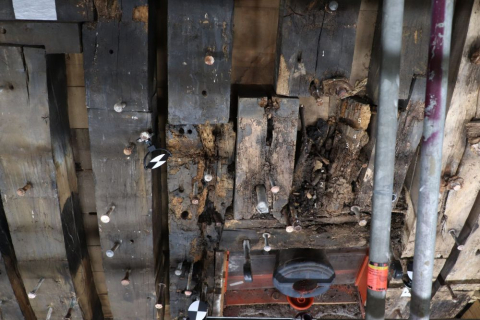
Plate1: Futtock WPE2224 in-situ, with the futtock 2220 to left, futtock 2226 to right, all above gunpoint LGD 12, futtock 2221 above and futtocks 2210 and 2215 to left of gunport.
Upon examination of the futtock, the bottom treenail (1) had discoloured to black, while the middle (2) and top (3) treenail appeared more similar in colour to the rest of the futtock. Treenail (3) protrudes out from the outer surface of the futtock, indicating that it would have engaged with an overlying external plank, while the other two treenails are flush with its surface, possibly indicating they had been cut back and may belong to an earlier set of planks. At least two channels (4 and 5) partially preserved near the top of the futtock survive from other fixings now absent and possibly of 20th century date. The largest channel (5) has iron staining and is substantial in diameter and could have accommodated a 1920s bolt.
The Removal of the Futtock
Usually, an archaeological block-lift tries to extract a whole item in one go, by placing supporting materials around it in-situ to support it, and to enable the lift to proceed in one action. The item can then be examined and conserved fully off site. Typically, archaeological block-lifts are performed in burial environments where material and artefact are extracted vertically. This block-lift required considerable planning to adapt the techniques for a horizontal lift instead.
One of the important factors for the successful removal of the futtock was to maintain its shape, to prevent material loss and to choose support materials that would not cause further material degradation. The support materials also needed to be removable. Different consolidation methods and adhesives were tested on sample material (wood of similar degradation to the futtock) to find the most suitable method. Once the chosen method was in place, the team were ready to head to the port side scaffold to undertake the block-lift. The area had already been cleaned off debris and loose historical material – all placed in labelled bags for the project’s sample archive.
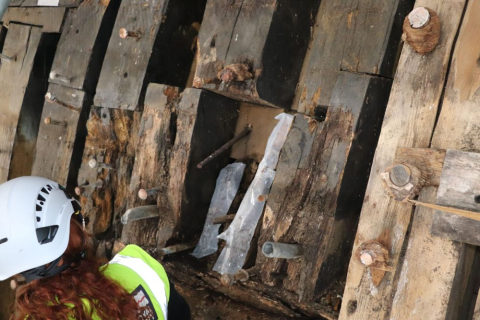
HMS Victory’s conservator attaching the supportive paper strips.
To ensure the futtock retained its structure during the lift, Japanese tissue paper strips were placed longitudinally and transversely onto the futtock and then carefully brushed with a solution of methylcellulose in distilled water. Once all strips were attached to the wooden surface, they were left to dry for a few hours. Theoretically, these strips alone should have been enough to hold the futtock together, but to provide further support, strips of Tyvek wetted with the same solution were added on top of the dried Japanese tissue paper support in a ‘rib cage’-formation . The Tyvek strips were removed later the same day after moving the futtock into storage.
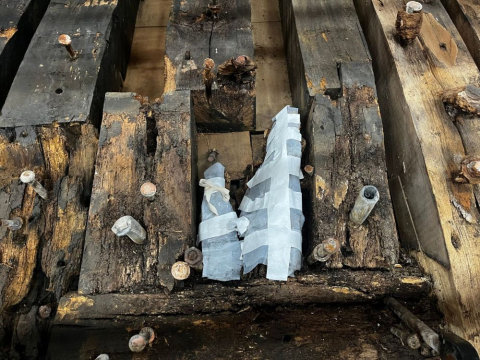
The futtock after being covered with support material ahead of the block-lift
Once the futtock had been fully covered by the support material, the team inserted thin aluminium sheets behind, underneath and on the sides of the futtock. The aluminium sheets were perfect for this purpose, as they were flexible enough to carefully insert them around the futtock. The aluminium sheets were carefully tied together using cotton tape. Due to the awkward position of the futtock, it had to be lifted out manually by the team.
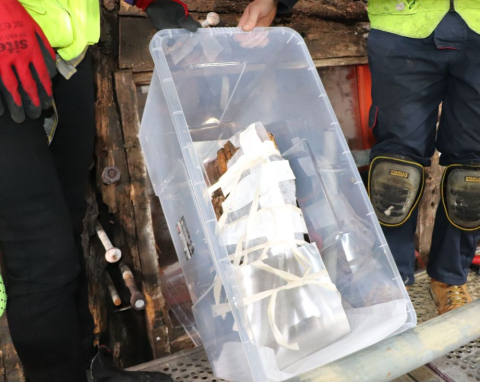
The futtock after removal
Concluding Remarks
Due to its historical significance, the risk of leaving the futtock in-situ in its highly degraded form posed a great risk to it being lost forever. Although its removal has arguably reduced its heritage significance as it is now ex-situ, it still preserves fabric and features that demonstrate its exceptional significance overall. The futtock is now in storage, and its shape is maintained with appropriate packing materials and consolidation. This will allow future research to be undertaken into its historic context, construction technique and material composition.
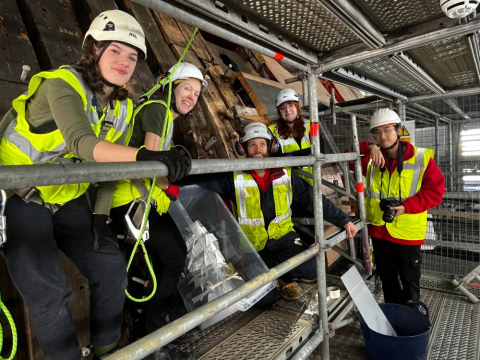
We are now looking forward to embarking on the next challenges as we are moving on to the next stages of the conservation project.
HMS Victory remains open to the public during The Big Repair, where visitors can continue to get on board the ship, with the added opportunity to watch the conservation project take place in real time from a three-storey viewing platform.
This article was first published in the January 2026 issue of Iconnect, the membership magazine of the Institute of Conservation (www.icon.org.uk). (c) Icon 2026.